

FDA Rewrote Device Quality Rules in February: What Contact Lens Buyers Should Ask
BAIYIN, Gansu Province, China, October 15, 2026
The U.S. Food and Drug Administration replaced the quality system rules that had governed medical device manufacturing since 1997 with a new framework that took effect on February 2, 2026. The Quality Management System Regulation, or QMSR, amends the current good manufacturing practice requirements of 21 CFR Part 820 and incorporates by reference ISO 13485:2016, the international standard for medical device quality management systems. The rule text is published on the FDA's QMSR page at https://www.fda.gov/medical-devices/postmarket-requirements-devices/quality-management-system-regulation-qmsr
The change is structural rather than cosmetic. On the same date, the FDA stopped using the Quality System Inspection Technique, known as QSIT, and began inspecting device manufacturers under Compliance Program 7382.850. Two earlier inspection documents, 7382.845 and 7383.001, were retired. The QMSR also incorporates clause 3 of ISO 9000:2015, which standardizes quality management terminology, and now explicitly requires risk management as part of the quality system.
Soft contact lenses are not among the device types exempt from these requirements. Under 21 CFR 886.5925, a soft (hydrophilic) contact lens is a Class II device if it is intended for daily wear only, and a Class III device if it is intended for extended wear. In the FDA's product classification database, daily wear soft contact lenses carry product code LPL, a submission type of 510(k), and a GMP exemption status of No. The QMSR therefore applies to every contact lens factory supplying the United States market.
For brand owners and importers, the practical consequence is that a familiar question has become less informative. Asking a prospective manufacturer whether it is FDA registered no longer separates suppliers, because establishment registration is a filing rather than an audit result. A more useful question is whether the factory's quality management system has been audited against ISO 13485, the standard the FDA now uses as its reference. Constar maintains a guide to the FDA 510(k) process for contact lens brand owners, which explains how clearance and quality system obligations divide between a factory and the brand that sells the product.
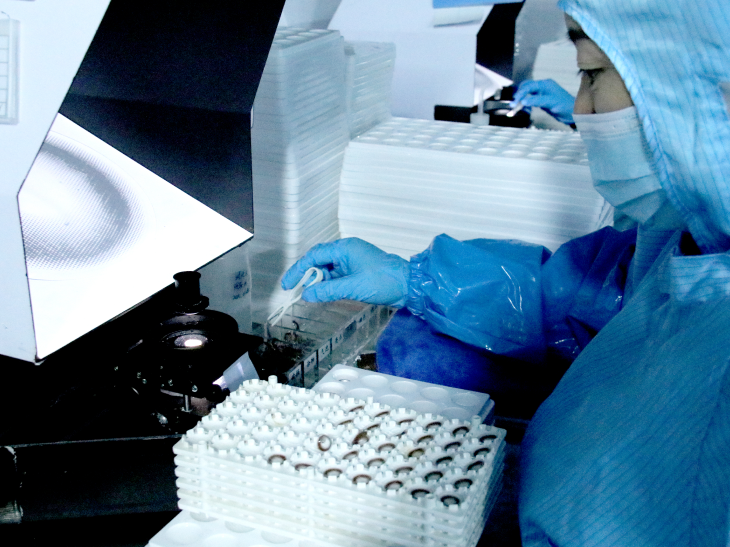
Constar, a contact lens manufacturer with six production facilities across Gansu and Hunan provinces in China, obtained ISO 13485 quality management certification in 2017, several years before the American rule changed. The company produces approximately 15 million lenses per month and holds CE certification for the European Union alongside FDA clearance. It also provides OEM, ODM and private label manufacturing for contact lens brands and distributors.
"The transition itself was not difficult for us, because we were already audited against ISO 13485 every year," said a quality management representative at Constar. "The harder shift is on the buyer side. Requirements that used to be verified at the end of a production run now have to be controlled through design and development, and that changes which documents a brand owner should expect to receive."
Constar suggests that buyers request four specific items rather than a general statement of compliance: the scope and expiry date of the current ISO 13485 certificate together with the registrar that issued it; the outcome of the most recent FDA inspection, including any Form 483 observations and the corrective actions taken; evidence that risk management is built into design and development rather than documented afterwards; and confirmation that the device is manufactured under the correct classification, because daily wear and extended wear contact lenses sit in different FDA classes with different submission requirements. A broader compliance checklist for vetting contact lens manufacturers is also published by the company at https://www.constarfactory.com/news/how-to-vet-contact-lens-manufacturer-compliance-checklist/
The harmonization is intended to reduce duplication for manufacturers who already sell in markets that require ISO 13485. The FDA has stated that where a clause of ISO 13485 conflicts with the Federal Food, Drug, and Cosmetic Act or its implementing regulations, United States law controls.
About Constar
Gansu Constar Technology Group Co., Ltd., which trades as Constar Factory, is a contact lens manufacturer headquartered in Baiyin, Gansu Province, China. The company operates six production facilities across Gansu and Hunan provinces with a combined output of approximately 15 million lenses per month, and supplies OEM, ODM and private label contact lens manufacturing to brands and distributors. Constar holds CE 0197 certification for the European Union and ISO 13485 quality management certification. The company states that it is the only contact lens manufacturer in China to hold FDA, CE and ISO 13485 certification simultaneously.
Gansu Constar
Gansu Constar Technology Group CO.,LTD
+852 91218475
info@constarfactory.com
Legal Disclaimer:
EIN Presswire provides this news content "as is" without warranty of any kind. We do not accept any responsibility or liability for the accuracy, content, images, videos, licenses, completeness, legality, or reliability of the information contained in this article. If you have any complaints or copyright issues related to this article, kindly contact the author above.
