

Prostate Cancer Treatment Market is expected to reach US$ 28.10 billion by 2033 | DataM Intelligence
Prostate Cancer Treatment Market
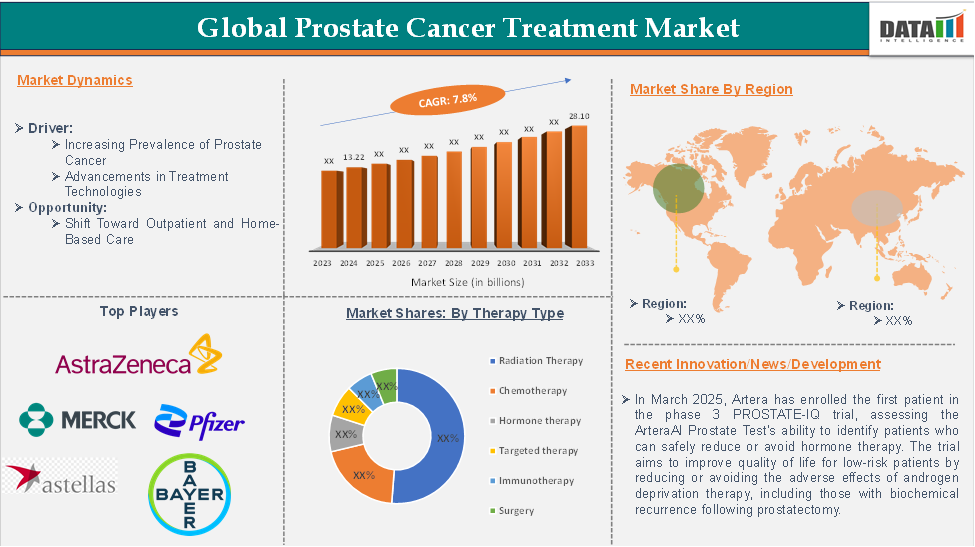
The Prostate Cancer Treatment Market is expected to reach at a CAGR of 7.8% during the forecast period 2025-2033.
The Prostate Cancer Treatment Market is expanding with precision therapies, rising screenings, and innovation in drugs and diagnostics driving better patient outcomes.”
AUSTIN, TX, UNITED STATES, December 19, 2025 /EINPresswire.com/ -- Overview of the Market:— DataM Intelligence
The Global Prostate Cancer Treatment Market has evolved into one of the most dynamic segments in the oncology industry, driven by accelerating research efforts, strong government support, technological innovations, and rising patient awareness toward early diagnosis. According to DataM Intelligence, The Global Prostate Cancer Treatment Market was valued at around US$ 13.22 billion in 2024 and is projected to reach US$ 28.10 billion by 2033, growing at a CAGR of 7.8% during the forecast period (2025–2033). A sharp rise in prostate cancer incidence particularly in men aged over 65 coupled with increasing adoption of targeted therapy, immunotherapy, and minimally invasive surgical treatments strongly shape the industry’s future. Growing healthcare investments, expanding screening initiatives, and wider access to oncology drugs also continue to fuel the demand for improved treatment frameworks globally.
To Download Sample Report Here: https://www.datamintelligence.com/download-sample/prostate-cancer-treatment-market
In this rapidly evolving market, drug therapy currently remains the leading treatment segment, driven by the rising use of androgen deprivation therapies (ADT), immunotherapeutics, and advanced hormonal drugs. Meanwhile, North America leads the global market, backed by strong healthcare infrastructure, early disease screening practices, and quick availability of FDA-approved cancer drugs. The region also benefits from strong reimbursement networks and major biopharmaceutical companies headquartered in the U.S. These indicators position the prostate cancer treatment market at the forefront of oncology innovations, with medical research suggesting a major transition toward personalized medicine in the coming decade.
Key Highlights from the Report:
Rising prostate cancer prevalence globally is pushing demand for targeted and immune-based treatment solutions.
Hormonal therapy remains the most widely adopted treatment approach, supported by long-term survival benefits.
North America leads the market, followed by Europe, due to stronger diagnostic capabilities.
Biopharmaceutical companies are investing heavily in clinical trials for next-generation prostate cancer therapeutics.
Hospital pharmacies dominate distribution due to higher patient footfall and advanced oncology care infrastructure.
Combination therapy demand is growing as patients respond better to dual-mechanism treatment approaches.
Market Segmentation:
The Prostate Cancer Treatment Market is segmented based on treatment type, therapy modality, stage of cancer, and end-user. Hormonal therapy leads the market, accounting for the highest revenue share due to its widespread application in early-stage and advanced prostate cancer treatment. Men with localized prostate tumors are increasingly being offered ADT, androgen receptor inhibitors, and anti-androgen drugs. In recent years, targeted therapy and immunotherapy (checkpoint inhibitors) have gained significant traction, owing to their ability to alter disease progression with fewer side effects than chemotherapy. Chemotherapy remains a valuable segment, especially for men who develop metastatic castration-resistant prostate cancer (mCRPC), where hormone therapy becomes ineffective.
On the basis of end-user, hospitals hold the largest market share, supported by patient access to advanced surgical treatments including robotic prostatectomy and radiation therapy. Specialty cancer centers and ambulatory clinics are witnessing rising adoption due to shorter waiting times and reduced treatment costs. Furthermore, research centers and academic laboratories play a critical role in therapy development, particularly in immuno-oncology and gene-based cancer studies. The growing trend of outpatient cancer treatment is likely to reshape future market distribution channels, especially within emerging economies.
Speak to Our Analyst and Get Customization in the report as per your requirements: https://www.datamintelligence.com/customize/prostate-cancer-treatment-market
Regional Insights:
Regionally, North America stands as the dominant market, led by high clinical spending, well-established healthcare frameworks, and greater patient awareness. The U.S. accounts for the largest share within the region, supported by advanced screening methods, including PSA blood tests and MRI-guided biopsies. Availability of premium-priced cancer drugs and strong insurance systems further boost market growth.
Europe follows closely, with Germany, France, Italy, and the U.K. accounting for the largest revenue contributions. The region benefits from clinical advancements, faster drug approvals, and strong government focus on cancer prevention. Meanwhile, the Asia-Pacific region is projected to grow at the fastest CAGR over the forecast period. Countries such as Japan, South Korea, India, and China are investing heavily in healthcare modernization, oncology device upgrades, and R&D capabilities. Increasing awareness about prostate cancer screening and rising life expectancy are also driving treatment adoption throughout the region.
Latin America and the Middle East & Africa show gradual growth driven by improving healthcare infrastructure, although treatment access remains limited in several countries due to lower per capita income and lack of medical expertise.
Market Dynamics:
Market Drivers
One of the most significant growth drivers is the rising incidence of prostate cancer worldwide propelled largely by aging populations, sedentary lifestyle trends, and improving diagnostic technologies. The growing demand for non-invasive treatment methods, including robotic surgeries and targeted therapies, is transforming patient pathways and significantly improving treatment accuracy. Increased R&D investments, partnerships between oncology drug developers, and rising drug approvals further advance market momentum. Developments in genetic testing and predictive biomarker research support early detection and successful treatment planning, encouraging the adoption of personalized therapy.
Market Restraints
High treatment costs remain a barrier, especially in middle-income and underdeveloped nations. Premium therapies, such as immuno-oncology drugs, are priced at significantly higher rates, restricting patient access. Side effects associated with chemotherapy and hormone therapy including bone weakening, anemia, and cardiovascular complications also limit treatment adoption. Moreover, inadequate awareness programs in rural regions delay early diagnosis, reducing patient survival chances. Research limitations and lengthy regulatory approval processes may also slow therapy development.
Market Opportunities
Expanding investment in precision oncology and immunotherapy development represents a major opportunity for industry players. Drug makers are exploring radioligand therapies, gene-based treatments, and vaccine-based tumor eradication. Emerging Asian economies are expected to shape future market demand due to increasing healthcare spending and growing acceptance of robotic surgical systems. The integration of artificial intelligence in oncology diagnosis presents scope for better risk analysis and tumor mapping, highlighting a new direction for predictive treatment models. Additionally, rising focus on combination therapies offers long-term disease control advantages, opening new revenue streams for biopharmaceutical companies.
Buy Now & Unlock 360° Market Intelligence: https://www.datamintelligence.com/buy-now-page?report=prostate-cancer-treatment-market
Frequently Asked Questions (FAQs):
How big is the Global Prostate Cancer Treatment Market today?
Which region dominates the prostate cancer treatment industry?
What is the projected growth rate of the Prostate Cancer Treatment Market?
Who are the key players operating in the global oncology treatment sector?
What is the market outlook for prostate cancer treatment through 2032?
Company Insights:
Key companies operating in the market include:
Astellas Pharma
AstraZeneca
Bayer AG
Dendreon Pharmaceuticals
Exelixis Inc
Ferring B.V
Johnson & Johnson (via Janssen Pharmaceuticals)
Pfizer Inc
Sumitomo Pharma Co., Ltd
Novartis
Tolmar, Inc
Recent Developments:
United States:
December: The FDA approved AKEEGA (niraparib and abiraterone acetate) as the first precision therapy for BRCA2-mutated metastatic castration-sensitive prostate cancer (mCSPC), reducing disease progression risk by 54% versus standard care in clinical trials.
November: UCLA Health researchers reported that PSMA-targeted radioligand therapy (177Lu-PNT2002) combined with stereotactic body radiotherapy (SBRT) doubled progression-free survival to 17.6 months in patients with recurrent prostate cancer, compared to 7.4 months with SBRT alone. This phase 2 LUNAR trial also delayed the need for hormone therapy by over 10 months while maintaining a favorable safety profile.
September: Prostate Cancer Awareness Month highlighted exciting developments like innovative PROTAC drugs and promising new clinical trials advancing targeted therapies.
Japan:
November: A retrospective study analyzed real-world treatment patterns for metastatic castration-sensitive prostate cancer (mCSPC) in Japan since 2020, showing shifts toward androgen receptor signaling inhibitors (ARSIs) and their impact on time to treatment discontinuation.
October: Curium Group, PeptiDream, and PDRadiopharma enrolled the first patient in a registrational Phase 2 trial of 64Cu-PSMA-I&T, a PET radiopharmaceutical for imaging high-risk prostate cancer prior to prostatectomy.
September: Policy recommendations were issued to promote nuclear medicine therapies like 177Lu-PSMA-617 for metastatic castration-resistant prostate cancer, addressing regulatory and infrastructure needs amid its pending approval.
Unlock 360° Market Intelligence with DataM Subscription Services: https://www.datamintelligence.com/reports-subscription
Conclusion:
The Global Prostate Cancer Treatment Market is undergoing a crucial transformation driven by medical breakthroughs, early screening adoption, and major investments in immunotherapy research. With strong market expansion expected through 2032, stakeholders from hospitals to pharmaceutical manufacturers are positioned for substantial revenue opportunities. Technological advancements, particularly in AI-based diagnostics, biologics, genomic studies, and minimally invasive cancer surgery, will continue reshaping clinical outcomes. As awareness spreads across developing nations and treatment affordability improves, the global prostate cancer treatment market stands ready to deliver long-term impact, empowering millions of patients with better survival prospects and enhanced quality of life.
Related Reports:
Prostate Cancer Biomarker Market
Prostate Cancer Diagnostics Market
Sai Kiran
DataM Intelligence 4Market Research
+1 877-441-4866
Sai.k@datamintelligence.com
Visit us on social media:
LinkedIn
X
Legal Disclaimer:
EIN Presswire provides this news content "as is" without warranty of any kind. We do not accept any responsibility or liability for the accuracy, content, images, videos, licenses, completeness, legality, or reliability of the information contained in this article. If you have any complaints or copyright issues related to this article, kindly contact the author above.
